Vinyl siding repair after a storm: what to check in Virginia Beach

The short answer
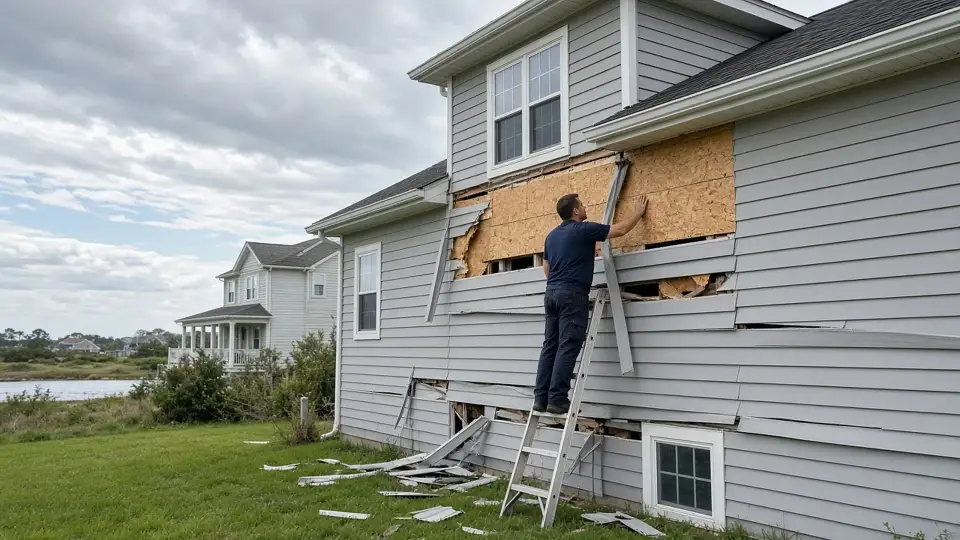
After a storm, look from the ground for missing, loose, cracked or wavy vinyl panels and damaged trim. Photograph everything before cleanup and call your insurer soon. One or two panels on a dry wall can usually be repaired. Damage on several walls means the wall behind the siding needs a check.
Coastal storms in Hampton Roads bring wind and rain at once. Both test every seam on a vinyl wall. This guide covers what we check after a storm and what to do first. It also explains how insurance and permits work in Virginia Beach.
The season points the same way. NOAA's winter outlook favors a wetter than average winter along the Eastern Seaboard. The Wakefield office's meteorologist in charge told WHRO he sees more storms developing right along our coast.
What does storm damage on vinyl siding look like?
Walk every side of the house from the ground. Check each wall from a few steps back, then up close at corners and openings.
- Missing panels: a gap where a course came unlocked and blew off. House wrap or sheathing may show through.
- Loose panels: sections that move or rattle in the wind. One loose lock can let a whole run peel.
- Cracks and holes: usually from flying debris. In severe cold, vinyl turns brittle and cracks more easily on impact.
- Wavy or buckled panels: often a sign of nails that were not driven straight and level, or were driven too tight.
- Bent trim and loose soffit: check the trim around windows and doors and the soffit under the eaves. A siding industry fact sheet on Hurricane Irma flagged soffit and fascia failures.
- Signs inside: water stains on walls or ceilings next to an outside wall.
Source: InterNACHI, Vinyl Siding Inspection, This Old House, Repairing Vinyl Siding, Vinyl Siding Institute, Hurricane Irma fact sheet
Why does vinyl siding blow off in high wind?
Vinyl is thin and flexible, so each panel locks onto the panels above and below it. When one lock lets go, wind can get under the course and pull it loose.
The wind rating and the install details decide how well a wall holds. The Vinyl Siding Institute's fact sheet on Hurricane Irma says improper installation can lead to blow-off.
| Detail | What the industry guidance says |
|---|---|
| Wind rating | Code standards call for 110 mph wind pressure on buildings up to 30 feet. The rating is on the label. |
| Nail spacing | Leave about 1/32 inch, the thickness of a dime, between the nail head and the siding. |
| Starter strip | Match it to the siding's lock. A mismatched strip can let the bottom course blow off. |
| Nail hem | Siding made for high-wind areas typically has a reinforced nail hem. |
What should you do first after a storm?
These steps protect the house and your claim.
- Look from the groundStay off ladders in wind or rain. Use your phone's zoom for second-story walls.
- Photograph every wallTake photos and video before you clean up or repair anything. Get wide shots and close-ups of each side.
- Stop more water getting inMake temporary repairs as soon as possible, like covering an open wall. Keep every receipt.
- Keep the piecesDo not throw away damaged siding until your insurer's representative has seen it.
- Call your insurerGive notice of a possible claim right away. In Virginia, insurers must acknowledge a claim within 10 working days.
- Get a written estimateAsk for a list of what needs repair or replacement, wall by wall.
Can you replace just one piece of vinyl siding?
Often, yes. A damaged panel can be unlocked with a zip tool, a small hooked pry bar. The nails come out, a new piece goes in, and the panel above locks back over it.
A patch works when the wall behind is dry and matching siding is still made.
Cold weather adds care. This Old House says vinyl bends best in summer, when the plastic is warmer and more flexible. InterNACHI notes that vinyl turns brittle in severe cold. In winter, a temporary fix may come first.
Repair a few panels or replace the wall?
| What you see | What it usually means | Next step |
|---|---|---|
| A few panels in one area, wall behind is dry | A repair | Replace the panels, then check the locks and nails. |
| Panels off and house wrap torn or sheathing wet | Water reached the wall | Open the area and check the sheathing before new siding goes on. |
| Damage on several walls, soft trim or stains | Wider water damage | Ask for a full inspection before choosing a repair. |
| Matching profile or color no longer made | A patch will show | Plan a full wall or the full house. |
We price each job with a free written estimate after a visit.
Does homeowners insurance cover wind damage to siding?
It depends on your policy and on what caused the damage. Storm damage is often covered and normal wear usually is not. Your insurer decides.
- Wind deductible: some policies carry a separate deductible for wind or hurricane losses. A percentage deductible is based on the coverage limit, not the damage: 2% of a $200,000 limit is $4,000.
- Flood: standard homeowners policies do not cover flood damage. Flood coverage is a separate policy.
- Temporary repairs: most homeowners policies cover the reasonable costs of emergency cleanup and temporary repairs. Keep a record of what you spend.
- Notice: homeowners policies issued in Virginia require immediate notice of a possible claim to your agent or company.
Source: Virginia SCC, hurricane season release, 2026, Virginia SCC, Disaster Strikes, Virginia SCC, Homeowners Insurance Guide
Our written estimate shows what needs to be repaired or replaced.
Do you need a permit to repair siding in Virginia Beach?
- City of Virginia Beach: lists siding replacements among residential work that needs a building permit. Siding gets a final inspection.
- Virginia building code: exempts siding replacement on homes only where the design wind speed is 100 mph or less.
Source: City of Virginia Beach, Residential Building Permits, Virginia USBC, 13VAC5-63-80
Small repairs may be treated differently from a full wall. Check with the city before work starts.
For property managers: logging storm damage across units
Scope storm damage by building and elevation. Log photos per wall, unit numbers, and each run as missing, loose or cracked.
Before day one, confirm the contractor's Virginia Class A RBC license and certificate of insurance. Ask for a written scope and schedule too. E3R holds Class A RBC license #2705200468 with no contract value limit. We provide a COI on request, keep a supervisor on site, and give you one point of contact.
Siding repair for damaged runs, water damage and trim is one of our commercial scopes.
Questions
What is the wind rating on vinyl siding? Code standards require siding to withstand wind pressure equal to 110 mph on buildings up to 30 feet high. The product's rating is on its label.
Do you need house wrap behind vinyl siding? Yes. Wind-driven rain can get behind vinyl, so building paper or house wrap belongs behind it, per InterNACHI.
Can you file a claim for wind damage to siding? Yes. Give your insurer notice right away and document the damage first. Coverage depends on your policy.
How E3R handles siding repair
We visit, inspect the siding, and check fascia, soffit, gutters and windows on the same visit. Then we send a free written estimate. We do not publish prices online.
When a wall is open, we check the sheathing before new siding goes up. If the house needs full replacement, a typical job takes 3 to 4 days once materials are on site.
Virginia Beach is our main service area, from our office in Norfolk.
Siding repair and replacement in Virginia BeachWe check the wall behind the siding and send a free written estimate.Ask about this guide
Your name, a phone number and the question. That is all.